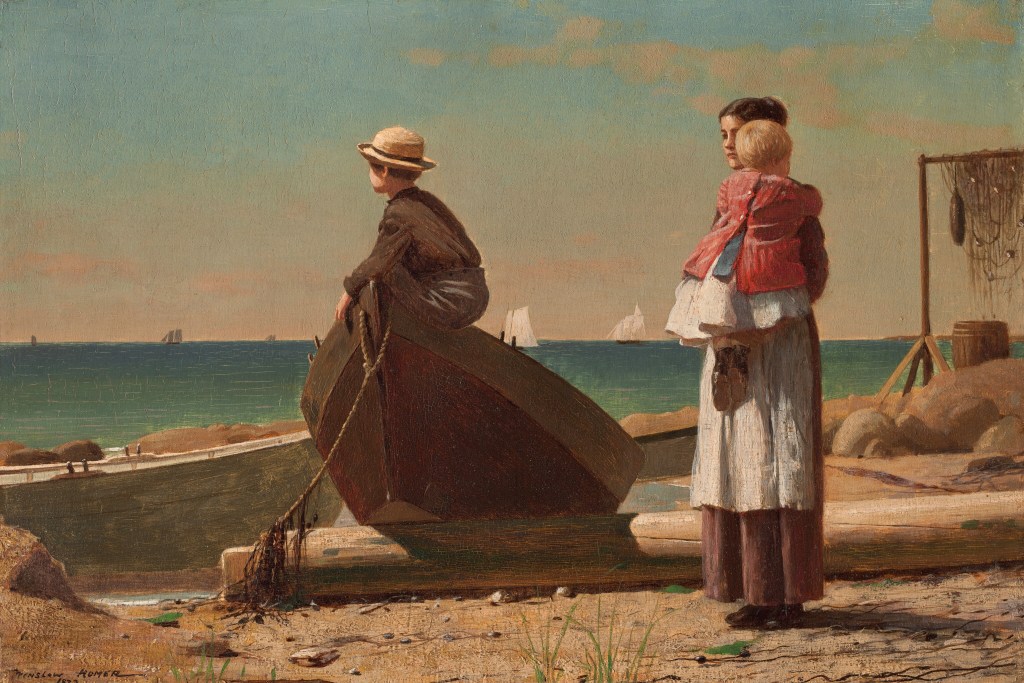
National Gallery of Art, Washington D.C.
In my office there are a few shelves dedicated to trinkets and special objects that hold special meaning. Toy figurines of Paul Atreides, Loki, and Shuri, a celestial sphere, my mother’s china jewelry box in the shape of a grand piano, and my childhood stuffed bear line the white shelves. When I glance in their direction, my mind wanders through the opaque hallways of memory, opening doors to secret rooms filled with images of who I am – who I believe myself to be.
We make sense of what it means to be human through stories. We do more than entertain ourselves with them, and they help us find our place in time and in history. Narratives form the foundation of our beliefs about a higher power and religion, politics and ethics, who we are and the choices we make. We tell stories about ourselves not only to connect with others, but as a part of self-discovery and forming identity. Young and old, and at all ability levels, we make connections and build a story out of those points of understanding. Yet, for some reason, we name only a select few in our social structure as those deemed worthy of telling our stories. We venerate skilled hands that convey rich imagery and sit back to enjoy the ride; but we, as audience, are very much a part of the storytelling relationship. In this way, story-seeing and story-hearing emerge as a result of the active position that story holds in our lives.
Both parts of this dynamic are integral parts to the narrative process, because the audience brings to the table prior information that influences the story itself. The experience of being human provides a layer of information that adds to the creative work, whether the creator likes it or not. Words, for instance, are just symbols for the ideas they represent, and once they are “out” in the world, the creator has little power over them. This has been long-discussed by artists and writers, with convincing arguments focusing on the purpose of art. While I’m not going to get into much of that here, it is important to recognize this back-and-forth relationship – a commitment, even – between the creator and audience, even if the audience is the creator herself.
Think about the kind of person you believe yourself to be and how this rises in the actions you take, including the way you dress, how you speak, if and how you share content on social media, the education and profession you choose, who you spend time with, the music you listen to, or your hobbies. Judith Butler and other theorists argue that we build our identities every day through these choices, and often they shift and change over time. In other words, we are writing stories through the decisions we make daily.
But naming them “stories” does not make them false. Rather, we can see the authenticity that lies in self-actualization.
It is entirely appropriate to assert that each and every one of us hold the position of -seer and -hearer almost all of the time. This is because it is in our nature to tell our story on multiple levels of invention, no matter age or ability. “See me.” “Know me.” “Hear me.” But do all these things through the filter that I create for you. Then, as the recipient of that information, we take it in and build that individual based upon our own perceptions. In the most ideal scenario, this can have beautiful results, rooted in authenticity and acceptance. In the most harmful way, however, the translation is poisoned with judgement and bigotry.
It is not often that we recognize our position as the audience who sees and hears someone else’s storytelling, but it is imperative that we do. We hold a form of power – not entirely in control, but with significant positioning. Story-seeing and story-hearing bring recognition and life to the narrative, deeming it acceptable or subversive – and conversely we tell our stories based on this reality.
It’s not very comfortable to be told that we engage in a back-and-forth dialogue when it takes so much effort to land on the words and images we want to use to express ideas. Personally, I bristle at the idea that I am not always making choices based on what I want, but on how others will perceive me. I cannot deny the relationship. It is clear that a connection exists as we form our identities and tell the world who we are.
Storytelling is not limited to professional writers, directors, artists, or musicians. We all tell stories every day about who we are. We are not faking it or pulling the wool over people’s eyes (usually.) Rather, it is the natural process of living in community and a key part of being human.
– Sarah

 Rock Your Story
Leave a comment